
Anti-Reflective vs Anti-Glare Coatings for Displays
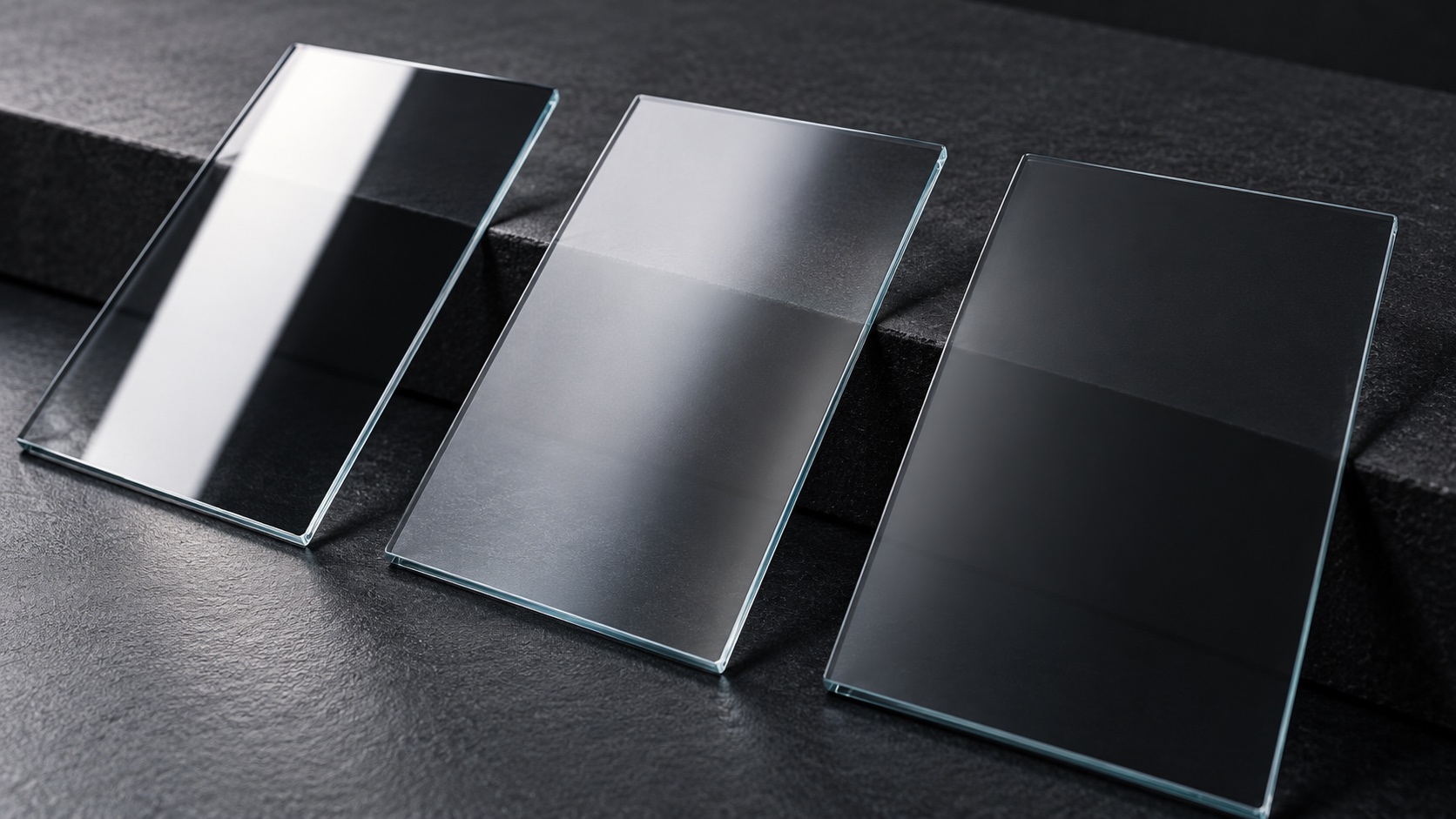
AR reduces reflection; AG changes how reflection is distributed. Anti-reflective surfaces aim to transmit more useful light and reduce reflected intensity. Anti-glare surfaces reduce distinct mirror-like reflections through controlled scattering. Choose between them by testing the finished screen’s readability, image clarity, and durability under its actual lighting.
This guide focuses on display cover surfaces, not corrective eyewear or a guaranteed coating specification. The Hero is an AI-generated illustration; sample behavior must be measured on real materials.
AR and AG Solve Related but Different Problems
| Characteristic | Anti-reflective, AR | Anti-glare, AG |
|---|---|---|
| Main mechanism | Reduces reflection through optical surface design | Redistributes light through texture or scattering |
| Typical visual effect | Reflections become weaker | Reflections become less sharply defined |
| Main specifications | Reflectance, transmission, wavelength, angle | Gloss, haze, clarity, sparkle, texture |
| Possible trade-off | Residual reflection color or angle dependence | Diffuse veil, image softening, or grain |
| Useful evaluation | Reflected intensity across viewing angles | Reflection spread and detail over actual pixels |
| Common selection mistake | Assuming any AR coating works at every angle | Treating matte appearance as proof of low total reflection |
The best surface may combine both mechanisms. It may also include an anti-fingerprint top layer, but that is a separate function; see anti-glare versus anti-fingerprint treatments for that comparison.
How Anti-Reflective Treatments Work
Many AR coatings use thin-film interference to reduce reflected light over a designed optical range. Their performance depends on substrate, wavelength, incidence angle, and coating construction.
The Edmund Optics AR coating guide explains why broadband and narrowband coatings differ. For a display, ask for specifications appropriate to visible light and expected viewing angles rather than selecting from a single impressive reflectance number.
Check whether a reflectance value describes one treated surface, a two-sided glass sample, or the complete display. A coating measured on an isolated coupon does not include reflection from internal touch layers or an unbonded LCD interface.
AR does not necessarily create a matte finish. A smooth low-reflection surface can still show a recognizable reflected object, simply at lower intensity. Residual reflected color can change with angle and should be assessed against the product’s appearance requirements.
How Anti-Glare Treatments Work
AG commonly uses controlled surface texture to scatter incident light. It can reduce the distraction of a sharp reflected window or lamp, but some of that light is redistributed into other viewing directions.
AGC’s display-screen glass range includes acid-etched anti-glare options with different gloss levels. This illustrates why “AG glass” is a family of surface choices rather than one fixed optical result.
The interaction with the display matters. Glass that looks attractive on a black desk may soften small text when placed over pixels. Surface microstructure can also produce sparkle that is more obvious at certain pixel densities, distances, or viewing angles.
Test the production thickness and spacing. A loose coupon held well above the LCD may not represent a bonded stack. Avoid selecting by haze alone: samples with similar haze can differ in clarity, texture, and visual grain.
Measure More Than a Marketing Label
Ask the supplier to define the test method and geometry for each promised property.
| Property | Question to resolve |
|---|---|
| Reflectance | Specular, diffuse, or total; which surface and angle? |
| Transmission | Visible weighting, spectral range, and full-stack losses? |
| Haze | Method, sample thickness, and acceptance tolerance? |
| Gloss | Measurement angle and treated side? |
| Image clarity | Which text sizes, pixel densities, and observation distances? |
| Sparkle | How is the actual display and viewing geometry represented? |
| Durability | Which cleaning, abrasion, chemical, and environmental conditions? |
A single “less than 1% reflection” statement is incomplete if its wavelength range or treated interface is unspecified. Likewise, a “low-glare” claim does not identify an acceptable level of image softness.
Choose for the Lighting and User Task
For a high-detail indoor instrument, preserving small text and line clarity may favor low-scatter solutions. For an HMI placed beneath strong ceiling lights, reducing distinct reflections may be a higher priority. For an outdoor screen, evaluate ambient contrast and temperature together.
These are design starting points, not categorical rules. A carefully chosen AG surface can preserve detail, and an AR surface can still produce an objectionable reflection in an unfavorable geometry. Use the sunlight-readable TFT guide for the full outdoor evaluation.
Touch feel and cleaning also affect the experience. Evaluate finger drag, fingerprints after repeated use, and visibility after the approved cleaning process. Do not assume a hard substrate guarantees the same scratch or chemical resistance for every coating on it.
Treat Bonding and Cover Construction as Part of the Decision
Outer-surface treatments cannot eliminate every internal reflection. Optical bonding can reduce reflection from selected air interfaces, while cover tinting changes transmission as well as appearance.
Evaluate the proposed glass together with adhesive, black-mask border, touch sensor, and LCD. The cover glass and OCA guide describes that construction context. Confirm that processing, cleaning, and bonding do not damage the selected surface treatment.
A sample with excellent optics but poor edge processing or unreliable coating adhesion is not ready for production. Put the finish and treated-side orientation on the controlled drawing, not only in an email description.
A Practical Sample Comparison Plan
- Mount candidate covers over identical displays using the intended spacing or bonding.
- Match screen luminance, image pattern, temperature, and viewing position.
- Use both a directional light source and representative diffuse lighting.
- Compare reflected objects, black-level washout, small text, and color detail.
- Move through expected viewing angles and check sunglasses if applicable.
- Repeat after fingerprints, approved cleaning, and specified durability exposure.
- Record measurements and photographs using fixed camera exposure.
Include solid black, gray, white, fine lines, and the actual user interface. A colorful demonstration image can conceal the haze or sparkle that becomes obvious in a production menu.
Keep an approved sample and numerical limits for incoming display inspection. The purchasing requirement should identify the complete finish and test conditions, so later batches can be compared consistently.
Frequently Asked Questions
What is the difference between anti-reflective and anti-glare displays?
Anti-reflective treatments reduce reflected light over specified wavelengths and angles. Anti-glare treatments scatter light to make sharp reflections less distinct. AG may introduce haze or sparkle, while AR performance depends on coating design and viewing conditions.
Can a display use both AR and AG?
Yes. A qualified surface stack can combine reflection reduction with controlled scattering. Assess the finished glass for reflectance, haze, clarity, durability, and compatibility rather than assuming the benefits simply add together.
Does a matte surface guarantee better sunlight readability?
No. Matte texture can reduce a sharp reflected image while spreading reflected light over a wider area. Outdoor readability depends on the complete display's ambient contrast and the actual viewing geometry.
What causes sparkle on an anti-glare display?
Interaction between surface microtexture and the underlying pixel structure can produce a grainy or sparkling appearance. Evaluate the glass on the intended display at its normal viewing distance, especially for high pixel density and fine text.
Is anti-fingerprint coating the same as AR or AG?
No. Anti-fingerprint treatments address oil adhesion, cleaning, or surface feel. They do not by themselves establish the same reflection-reduction or scattering behavior as AR or AG.