
What is Color Temperature Matching in TFT LCD Displays?
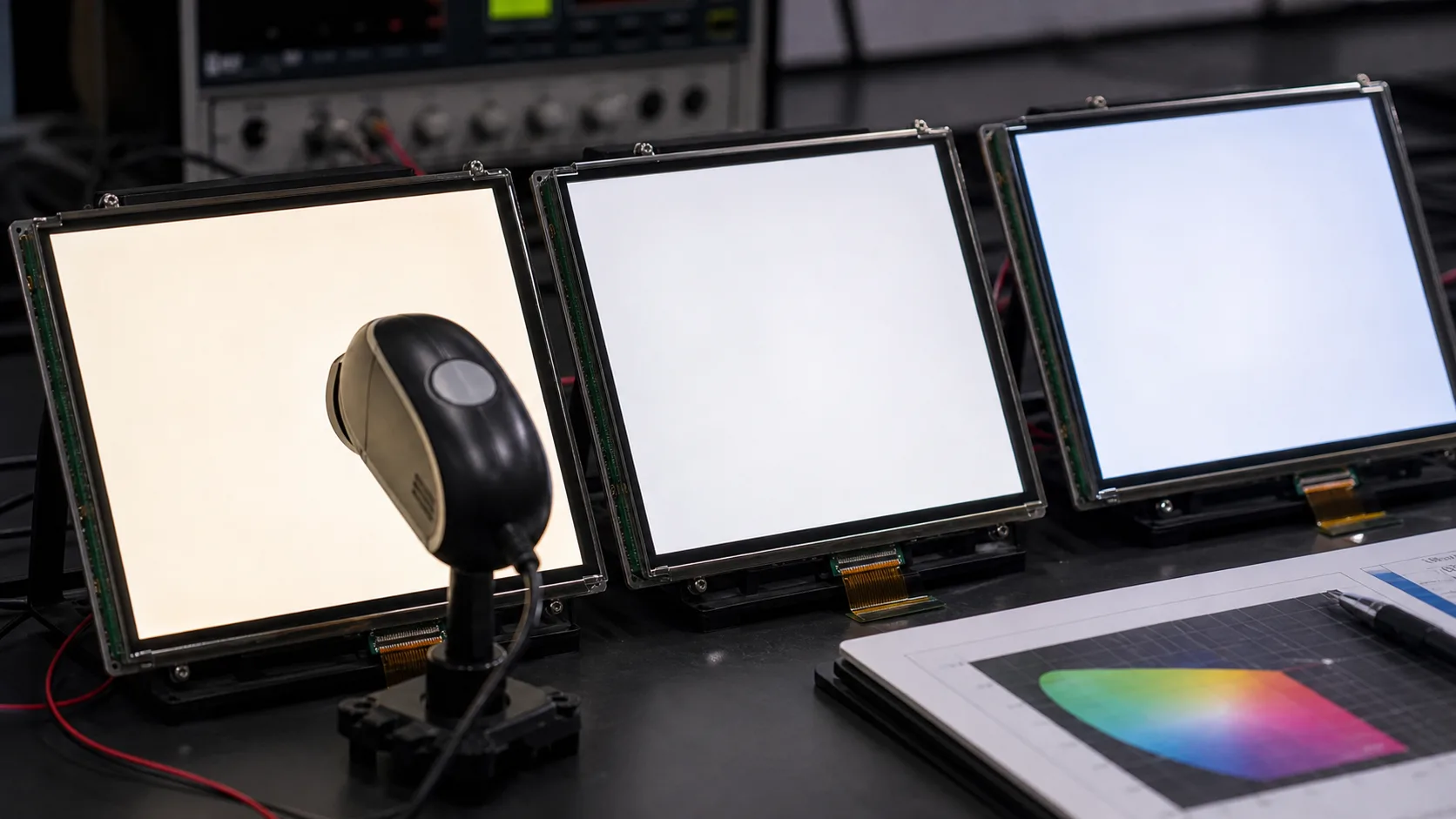
Color Temperature Matching in TFT LCD Displays: Why It Matters in Industrial and Embedded Systems
When engineers evaluate a TFT LCD display, the first specifications they usually check are resolution, brightness, interface type, and viewing angle. Color performance is often discussed as well, especially for IPS displays or high-end industrial panels.
However, one parameter that is frequently underestimated in embedded products is color temperature matching.
In real production environments, color temperature inconsistency can become surprisingly obvious, especially when multiple displays are installed side-by-side or when replacement modules come from different manufacturing batches.
Even when two TFT LCD modules use the same LCD panel model, they may still appear visually different. One screen may look slightly bluish while another appears warmer or yellowish. In industrial systems, this difference can negatively affect perceived product quality.
For consumer electronics, minor color variation is often tolerated. Industrial and professional systems are different. Products such as medical equipment, industrial HMI panels, automotive displays, and control terminals often require more consistent visual characteristics.
This is where color temperature matching becomes important.
This article explains what color temperature means in TFT LCD displays, why matching matters in industrial systems, what factors affect color consistency, and how manufacturers typically handle calibration during production.
What Is Color Temperature?
Color temperature describes the visual appearance of white light emitted by a display.
It is usually measured in Kelvin (K).
Lower color temperatures appear warmer and more yellowish, while higher temperatures appear cooler and more bluish.
Typical examples include:
| Color Temperature | Visual Appearance |
|---|---|
| 2700K | Warm yellow light |
| 4000K | Neutral warm white |
| 6500K | Standard daylight white |
| 9300K | Cool blue-white |
Most TFT LCD displays are calibrated somewhere between 6500K and 7500K.
In industrial displays, 6500K is commonly used because it produces a more natural white balance.
Why Color Temperature Matching Matters
Many engineers assume that displays from the same supplier will automatically look identical.
In practice, this is rarely true without calibration.
Several factors can cause visible color variation:
- LED backlight differences
- LCD panel tolerances
- Optical film variation
- Polarizer characteristics
- Driver IC behavior
- Aging effects
As a result, two displays from different production batches may have noticeably different white tones.
Typical problems include:
- One display appears bluish
- Another display looks warmer
- Gray colors appear inconsistent
- White backgrounds do not match
- Multi-display systems look uneven
In industrial products, users notice these differences quickly.
Even non-technical customers often describe the issue as:
- “The screens don’t look the same”
- “One display looks colder”
- “The colors are different”
This affects perceived product quality significantly.
White Point and Human Perception
Human eyes are extremely sensitive to white balance differences.
Even relatively small changes in color temperature can become obvious when displays are placed next to each other.
For example:
| Display | Color Temperature |
|---|---|
| Display A | 6500K |
| Display B | 7800K |
Both displays may technically function correctly, but visually they will not match.
The difference becomes even more noticeable in products with:
- White user interfaces
- Medical imaging systems
- Industrial control rooms
- Multi-monitor environments
This is one reason why professional display manufacturers invest considerable effort into color calibration.
The Backlight Is Usually the Main Source of Variation
In TFT LCD modules, the LCD panel itself does not generate light.
The visible white color mainly comes from the LED backlight system.
As a result, color temperature variation is usually dominated by LED characteristics.
The backlight system typically includes:
- White LEDs
- Diffuser films
- Prism films
- Light guide plates
- Reflective layers
Small variations in LED phosphor composition can change the final white appearance noticeably.
For example:
| LED Batch | Measured Color Temperature |
|---|---|
| Batch A | 6200K |
| Batch B | 7100K |
| Batch C | 7600K |
Without compensation, displays assembled using these batches will not visually match.
Why Industrial Products Require Better Matching
Consumer devices are often replaced within a few years.
Industrial products are different.
Many industrial systems remain in service for:
- 5 years
- 10 years
- Sometimes even longer
Replacement displays may therefore come from completely different manufacturing batches.
If color temperature control is poor, the new display may look obviously different from the older unit.
This becomes especially problematic in:
- Medical systems
- Factory automation
- Transportation equipment
- Professional control systems
Visual consistency is important for maintaining product quality perception.
Common Methods Used for Color Temperature Matching
Manufacturers use several approaches to improve color consistency.
1. LED Binning
LED binning is one of the most common methods.
During LED manufacturing, LEDs are sorted into groups based on:
- Brightness
- Forward voltage
- Color temperature
Only LEDs from the same bin are used together in a display module.
Typical LED binning categories include:
| Parameter | Purpose |
|---|---|
| Brightness bin | Match luminance |
| Voltage bin | Improve electrical consistency |
| Color bin | Match white balance |
This reduces visible variation between display modules.
2. Optical Calibration During Production
Some manufacturers measure displays during final assembly.
Optical instruments measure:
- Brightness
- White point
- Color coordinates
- Uniformity
The backlight or display controller settings are then adjusted to match the target specification.
Higher-end industrial displays may undergo calibration individually.
3. Gamma and RGB Adjustment
Some display controllers allow independent adjustment of:
- Red gain
- Green gain
- Blue gain
This enables fine tuning of white balance.
Typical calibration process:
| Step | Purpose |
|---|---|
| Measure white point | Determine actual color temperature |
| Adjust RGB gains | Correct color balance |
| Verify grayscale | Ensure smooth transitions |
| Save calibration values | Store factory settings |
This process is more common in professional displays and medical systems.
4. Software Compensation
Some embedded systems apply software-based color correction.
This may involve:
- Gamma tables
- RGB lookup tables
- Color correction matrices
Software compensation is commonly used in systems with GPU-capable processors.
However, low-cost MCU systems usually rely more on hardware consistency.
Why IPS Displays Sometimes Show More Visible Differences
IPS displays are widely used because they provide:
- Better viewing angles
- More stable colors
- Improved image quality
However, because IPS panels produce more accurate color reproduction, color temperature differences may also become more visible.
In TN displays, limited viewing angle and lower contrast often mask some color inconsistency.
In high-quality IPS panels, users can more easily notice white balance variation between displays.
Environmental Factors That Affect Color Temperature
Even after factory calibration, color temperature can still change during operation.
Several factors contribute to this.
Temperature Effects
LED spectral output changes with temperature.
Typical behavior:
| Operating Temperature | Visual Effect |
|---|---|
| Low temperature | Cooler appearance |
| High temperature | Slightly warmer appearance |
Industrial systems operating across wide temperature ranges may therefore experience small white balance shifts.
LED Aging
LEDs gradually change characteristics over time.
Long-term aging may cause:
- Reduced brightness
- White point drift
- Yellowing effects
This is especially visible in high-brightness outdoor displays operating continuously.
Optical Film Aging
Diffuser films and polarizers may also age over time.
Extended UV exposure and heat can affect optical properties, slightly altering display appearance.
Multi-Display Industrial Systems
Color temperature matching becomes especially important in systems containing multiple displays.
Examples include:
- Industrial control rooms
- Medical workstations
- Transportation monitoring systems
- Broadcast equipment
If one display looks cooler than another, the inconsistency becomes immediately noticeable.
Even a small mismatch can create the impression of poor product quality.
Typical Industrial Color Temperature Targets
Most industrial TFT LCD products target a white point near 6500K.
Typical values include:
| Application | Typical Target |
|---|---|
| Consumer electronics | 7000K–9300K |
| Industrial HMI | 6500K |
| Medical displays | 6500K with tighter tolerance |
| Automotive displays | 6500K–7500K |
Medical systems often require stricter calibration because color accuracy directly affects image interpretation.
The Relationship Between Color Temperature and Brightness
Brightness and color temperature are closely related.
Changing LED current may slightly affect white balance.
For example:
| Backlight Current | Possible Effect |
|---|---|
| Lower current | Slightly warmer appearance |
| Higher current | Slightly cooler appearance |
This means brightness calibration and color temperature calibration are often performed together.
Challenges for Low-Cost Embedded Products
In low-cost embedded products, perfect matching is difficult because of cost limitations.
Several constraints exist:
- Lower-cost LEDs
- Wider component tolerances
- Limited calibration time
- No optical measurement equipment
- Simplified production flow
As a result, low-cost products may show more noticeable variation between units.
Industrial-grade products typically use tighter component selection and stricter quality control.
Why Engineers Should Care About Color Matching Early
Many engineers only notice color mismatch during late production stages.
At that point, fixing the problem becomes expensive.
It is usually better to define color temperature requirements early during product development.
Important considerations include:
- Target white point
- Allowed tolerance range
- LED supplier consistency
- Calibration method
- Long-term replacement strategy
Ignoring these factors early can create significant consistency problems later.
Conclusion
Color temperature matching is an important but often overlooked aspect of TFT LCD display design and manufacturing.
Even displays using the same LCD panel model can appear visually different because of LED variation, optical tolerances, and environmental factors.
In industrial embedded systems, where products often operate for many years and may include multiple displays, visual consistency becomes especially important.
Proper color temperature control helps improve:
- Product appearance
- User experience
- Multi-display consistency
- Long-term maintenance quality
Although perfect matching increases manufacturing complexity and cost, it remains an important part of professional TFT LCD display engineering, especially in industrial, medical, and high-reliability embedded applications.
In practice, this topic is rarely isolated: cover glass and OCA bonding can affect the same mechanical and electrical choices. Teams should also check TN, IPS, and VA panel differences before freezing samples for a consumer device.