
OCA Bonding vs Air Gap for TFT Touch Modules
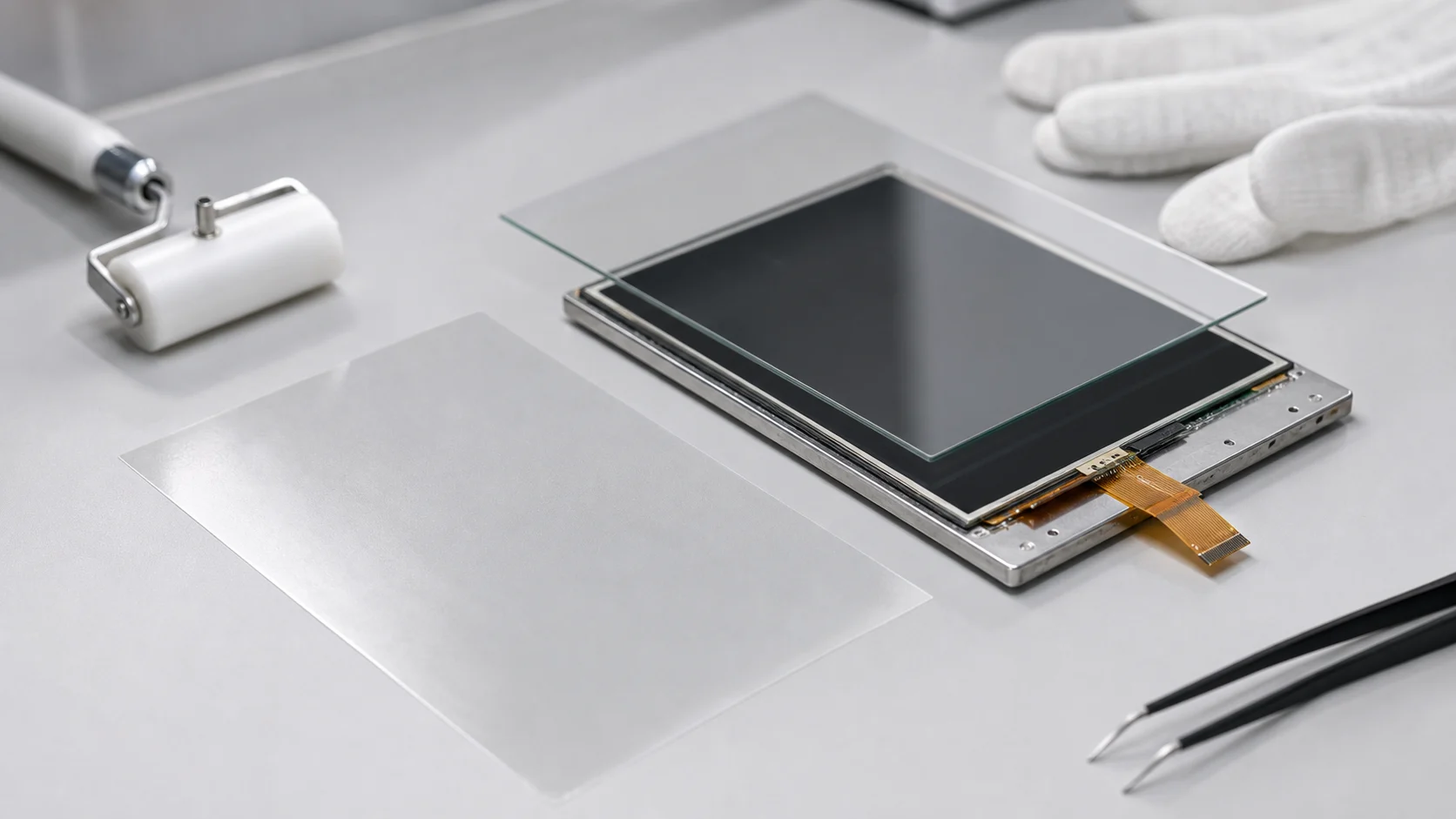
The space between the cover glass and TFT display is easy to overlook, but it has a large effect on how a touch product looks and feels. Two common assembly choices are air-gap construction and OCA bonding. Both can work. The right choice depends on readability, cost, repair strategy, touch feel, and production capability.
OCA means optically clear adhesive. It is a solid adhesive film used to laminate transparent layers. In a TFT touch module, OCA may bond the cover glass to the touch sensor, the touch sensor to the LCD, or both. By filling the air space, it reduces reflections between surfaces and makes the front stack behave more like one solid piece.
Air-gap assembly leaves a space between layers, usually controlled by a frame, gasket, or adhesive around the edge. It is simpler and can be easier to repair, but the extra reflective surfaces can reduce contrast and create a less premium touch feel.
Optical Difference
Every air interface reflects light. In a simple air-gap stack, light can reflect at the cover glass, air gap, touch sensor, and LCD surface. Under bright indoor lights or near a window, these reflections make dark areas look gray and reduce perceived contrast.
OCA bonding reduces those internal reflections because the adhesive has an optical index closer to glass and plastic layers than air does. The result is usually better black appearance, stronger contrast, and clearer graphics. The display may not be brighter in a measured backlight sense, but it can look more readable because less ambient light is reflected back to the user.
This matters most for smart home panels, appliance displays, handheld products, payment terminals, outdoor-adjacent devices, and premium consumer controls.
Touch Feel and Mechanical Strength
OCA bonding can make the front surface feel more solid. Users may not describe it technically, but they often notice when a touch panel feels hollow or when the image appears separated from the glass. Bonding reduces that visual and tactile gap.
A bonded stack can also improve impact distribution because the layers support each other. This does not make the product unbreakable, but it can help reduce local stress and prevent dust or moisture from entering the viewing area.
Air-gap designs can still feel good when the mechanical frame is stiff and the gap is controlled. They are common in cost-sensitive products, products with repair requirements, and designs where optical performance is less critical.
Production and Repair Trade-Offs
OCA bonding requires cleaner process control. Dust, bubbles, alignment errors, and adhesive handling can affect yield. Larger panels are harder to bond than small panels because trapped bubbles and flatness issues become more visible.
Air-gap assembly is usually more forgiving. If the cover lens breaks, it may be easier to replace without scrapping the LCD. For serviceable industrial equipment, that can matter. For sealed consumer products, repairability may be less important than appearance and touch quality.
| Decision Point | OCA Bonding | Air Gap |
|---|---|---|
| Reflection | Lower | Higher |
| Touch feel | More solid | Can feel separated |
| Repair | Harder | Easier |
| Process control | Higher requirement | Lower requirement |
| Dust risk in viewing area | Low after bonding | Higher if sealing is weak |
| Premium appearance | Strong | Depends on design |
Common Mistakes
The first mistake is choosing bonding only by cost. If the product is used under strong light, the cheaper air-gap option may create a worse screen experience even when the LCD panel is good.
The second mistake is specifying OCA without checking production capability. The supplier should explain bonding size limits, acceptable bubble criteria, rework strategy, and inspection method.
The third mistake is testing only one sample. Bonding quality should be reviewed across multiple units because small dust particles, edge bubbles, and alignment shifts may not appear in the first sample.
Inspection Criteria
Bonded modules need clear inspection rules. Define acceptable limits for bubbles, dust, edge overflow, Newton rings, yellowing, and alignment shift. A tiny particle near the hidden border may be acceptable, while the same particle in the active area should fail. Without these rules, production teams and suppliers may judge the same sample differently.
For touch products, inspection should include both cosmetic and functional checks. A bonded stack can look clean but still have weak edge touch if adhesive thickness, cover glass, or sensor placement changed. Test touch response after bonding, after thermal cycling, and after any cleaning process that the product is expected to survive.
Cost and Volume Planning
OCA bonding cost depends on panel size, yield, fixture design, adhesive material, and cleanliness requirements. Small products may bond reliably with modest tooling, while larger cover lenses need more careful lamination control. If the product is early in development, ask the supplier for both prototype and mass-production assumptions so the first quotation does not hide later yield risk.
Air-gap assembly remains attractive when volume is low, service replacement is important, or the product is used indoors with limited reflection concerns. OCA becomes easier to justify when the display is a visible part of product quality.
Practical Recommendation
Use air-gap assembly when cost, repairability, and process simplicity matter more than premium optical performance. Use OCA bonding when the product needs better contrast, a cleaner front surface, stronger touch feel, or reduced reflection.
For adjacent decisions, review optical bonding for consumer touch screens and cover glass options for consumer TFT displays. Bonding should be chosen together with cover lens design, not after the front surface is already finalized.
Frequently Asked Questions
What is OCA bonding in a TFT touch module?
OCA bonding uses optically clear adhesive film to laminate the cover glass, touch sensor, and display layers. It removes the air gap and reduces internal reflections.
Is OCA bonding always better than air gap?
No. OCA bonding improves optical performance and touch feel, but air-gap assembly can be cheaper and easier to repair. The right choice depends on product positioning, environment, and production volume.
When should a product avoid air-gap assembly?
Air-gap assembly should be avoided when reflections, condensation, dust, or a hollow touch feel would damage the user experience. Bright rooms and premium touch panels often benefit from bonding.