
MOQ, NRE, and Tooling Costs for Custom TFT Displays
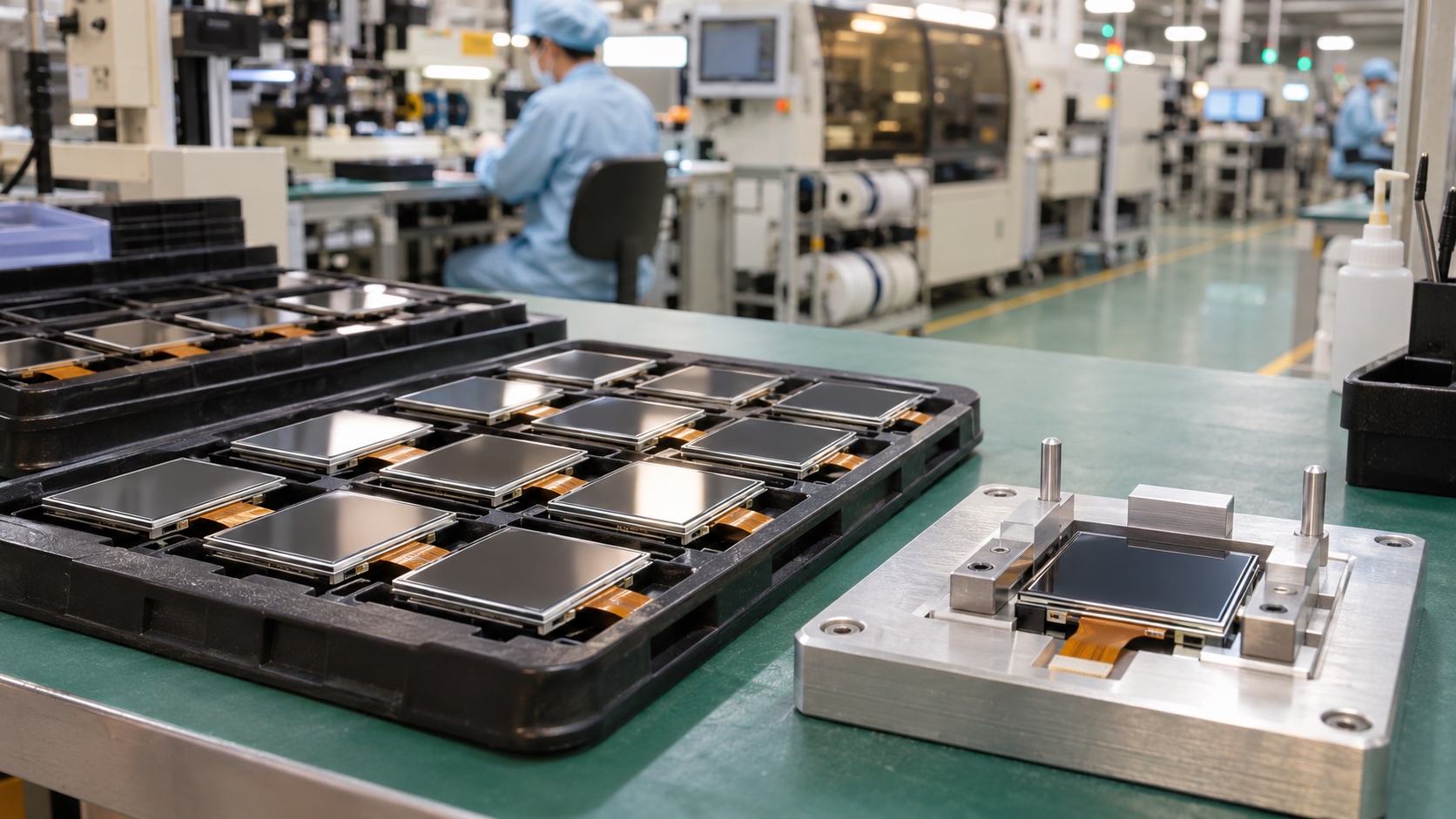
MOQ defines the minimum order quantity, NRE covers specified non-recurring engineering work, and tooling charges fund defined production assets. These terms describe different commitments. Compare quotations by their complete scope, payment milestones, and ownership terms rather than unit price alone.
Understand the Cost Categories
| Item | Typical purpose | Clarification needed |
|---|---|---|
| MOQ | Minimum accepted order or production batch | Per order, variant, or release? |
| NRE | Design, engineering, software, or validation work | Exact deliverables and revision allowance |
| Tooling | Masks, dies, fixtures, or other dedicated assets | Ownership, maintenance, storage, transfer |
| Samples | Prototype materials and assembly | Build stage and representativeness |
| Unit price | Recurring delivered assembly cost | Quantity, test scope, yield assumptions |
| Logistics | Packaging and shipping arrangements | Included charges and delivery terms |
Suppliers may group these items differently. Request a written breakdown instead of assuming an “engineering fee” includes every fixture and qualification activity.
Customization Scope Drives the Quote
A printed cover lens, modified FPC, bonded touch stack, and newly designed LCD panel are materially different projects. The Newhaven customization overview illustrates the range of display modifications. It does not establish market-wide prices or minimum quantities.
Use the custom TFT display modules guide to identify which elements actually need modification. Keeping a standard panel while changing a cover or cable may be feasible, but engineering review must establish compatibility and economics.
Ask What MOQ Actually Commits You To
A quoted MOQ can apply to one purchase order, one production run, one color, one touch configuration, or a minimum material purchase. Ask whether releases can be split, how long stock can be held, and which party carries unused material.
An annual forecast is not automatically an order commitment. Conversely, a supplier may buy custom material against an approved commitment even before final assembly. Make cancellation, rescheduling, and excess-inventory terms explicit.
Do not assume a higher MOQ is purely a negotiation tactic. Batch processes, material purchasing, setup, and yield can affect feasible quantities. Ask for alternatives such as standard materials or fewer variants and compare the resulting product trade-offs.
Define NRE Deliverables and Milestones
List drawings, prototypes, configuration files, engineering reviews, test reports, and production documentation where included. Agree how many sample iterations are covered and how requirement changes affect cost.
Payment milestones should correspond to reviewable outcomes. For example, a project might distinguish drawing approval, prototype delivery, and production readiness. The correct structure depends on the agreement; no universal deposit percentage is implied here.
Include a change process. If the enclosure changes after a cover tool is approved, who pays for redesign and scrap? A clear decision record is more useful than an informal promise that adjustments are included.
Tool Ownership Is More Than Paying an Invoice
Clarify legal ownership, physical location, permitted use, expected life, maintenance responsibility, and access at project end. Ask what data or hardware can be transferred and what proprietary supplier processes remain unavailable.
A dedicated fixture may only work on a particular production line. Owning it does not necessarily create a portable manufacturing process. Check whether replacement tooling would require requalification.
Identify repair and replacement charges, storage conditions, and consequences of inactivity. These details matter for products with intermittent demand or a long service period.
Compare Total Cost with Transparent Arithmetic
A simple planning model is:
Average acquisition cost per unit =
(unit price × purchased quantity + one-time charges) / purchased quantity
For a hypothetical order of 2,000 units at $18 each with $4,000 in one-time charges, the result is $20 per unit. These invented values illustrate allocation and are not a market quotation.
This model excludes freight, tax, inventory carrying cost, scrap, warranty, and redesign. Use committed quantities for a firm comparison and label forecast-based scenarios clearly. A lower apparent average based on uncertain future volume can hide a larger cash commitment.
Normalize Quality and Test Scope
Ask whether the quoted assembly includes optical bonding, touch tuning, functional testing, cosmetic inspection, and traceability. Compare the same accepted deliverable and defect criteria.
Use the RFQ checklist to align proposals and the incoming inspection checklist to define receiving expectations. Samples should identify hardware and process revisions so a lower-cost production substitution does not go unnoticed.
A Purchasing Review Before Approval
Confirm scope, quantities, milestones, delivery assumptions, tooling rights, engineering outputs, acceptance criteria, change control, and supply continuity. Record exclusions and unresolved assumptions in the quotation comparison.
When budget is tight, ask suppliers to price specific alternatives: standard versus modified FPC, bonded versus unbonded stack, or one variant versus several. Evaluate the resulting usability and assembly consequences alongside the savings.
The best commercial decision is the one that funds the required design and production controls at a commitment the product program can support.
Hero image: AI-generated editorial illustration.
Frequently Asked Questions
What is NRE for a custom TFT display?
NRE funds agreed non-recurring engineering deliverables such as design, sample iterations, or validation work.
Does paying for tooling guarantee transferability?
No. Ownership, location, transfer rights, and process dependencies need explicit agreement.
Is there a universal MOQ for custom displays?
No. MOQ depends on the specific materials, design, production process, variant count, and supplier agreement.