
TFT LCD Backlight Lifetime and L70 Explained
L70 is the point at which light output has decreased to 70% of its initial value under stated conditions. It describes lumen or luminance maintenance in the defined measurement system. It does not mean that 70% of displays survive, and it is not automatically the lifetime of the complete TFT module.
The DOE lifetime and reliability fact sheet distinguishes light-output maintenance from other failure mechanisms. For a TFT specification, confirm whether the supplier uses LED flux or finished-screen luminance and how the endpoint is determined.
Separate Three Lifetime Claims
| Claim | Meaning | Missing information to request |
|---|---|---|
| Backlight maintenance | Output retained relative to its initial value | Temperature, current, measurement method |
| Component survival | Fraction avoiding a defined failure | Failure definition and population |
| Module service life | Useful operation of the whole assembly | All limiting mechanisms and use conditions |
A display can remain electrically functional after its brightness becomes inadequate. It can also fail because of a connector, driver, adhesive, or another part before reaching the backlight’s maintenance threshold.
Why White LEDs Age
White backlights commonly use LED packages with conversion materials and an optical system. The US Department of Energy LED overview explains phosphor-converted and other methods of producing white light. The complete backlight adds light guides, films, reflectors, and thermal paths.
A maintenance statement measured on LED packages does not by itself establish finished-display luminance maintenance. Optical materials, operating temperature, drive conditions, and assembly differences need their own evaluation.
Read the Conditions Behind the Hour Figure
Ask whether the figure is measured or projected, which output quantity is used, and how failures are handled. Request sample quantity, exposure duration, drive current, temperature location, and the projection method if extrapolation is involved.
A headline “50,000 hours” without conditions is not a complete engineering specification. Do not assume it applies at maximum brightness in a hot sealed enclosure. Likewise, an LED ambient-temperature figure may not be equivalent to the temperature of the critical internal junction.
Use the operating-temperature guide to separate permitted operation from environmental storage exposure.
Translate Hours into a Duty-Cycle Question
For illustration, 30,000 operating hours divided by 10 hours per day is 3,000 operating days, about 8.2 years if used every day. This is arithmetic using an invented lifetime value, not a prediction for a particular display.
The calculation assumes the quoted operating conditions remain applicable. It excludes calendar aging and failures of other components. Variable brightness and temperature make a real usage profile more complicated than a single hour counter.
Record actual brightness settings, active hours, standby behavior, enclosure temperature, and environmental exposure. A useful supplier discussion begins with that profile instead of asking for the largest advertised number.
Design Around Required End-of-Life Brightness
Suppose a hypothetical application needs at least 350 cd/m² at the end of its defined service period. If a supported maintenance assumption were exactly 70%, initial brightness would need to be at least 350 / 0.70 = 500 cd/m² before other allowances.
This simplified example does not include production spread, cover losses, contamination, or measurement uncertainty. Nor does it authorize overdriving the LEDs. Agree the full-stack starting minimum and maintenance evidence with the supplier.
The brightness calibration workflow helps keep measurements consistent. Compare units at the same temperature, drive setting, warm-up condition, and geometry.
Manage Heat and Drive Deliberately
Higher current can increase initial brightness while changing thermal stress and maintenance behavior. Use the supplier’s approved drive limits and characterize the final enclosure at sustained operation.
Dimming can reduce average energy use, but its lifetime effect depends on current waveform, thermal behavior, and materials. Avoid applying an unsupported universal multiplier to a PWM duty cycle. Track peak drive as well as average power.
Check whether automatic thermal limiting reduces luminance before the service-life target. A design that preserves the backlight by dimming may still fail the user’s readability requirement during normal hot operation.
Validate and Monitor
Establish baseline luminance, color, uniformity, and input current. Recheck at defined intervals under repeatable reference conditions. Keep failed units in the record rather than reporting maintenance only for survivors.
Combine supplier evidence with application qualification and a replacement strategy. Do not label a short burn-in exposure as proof of a multiyear maintenance target. Burn-in, accelerated stress, and lifetime projection answer different questions.
For production, record the backlight configuration and require appropriate change notification. A replacement LED or optical film can change brightness, color, or maintenance even if the module outline stays the same.
What to Ask Before Approval
Request the maintenance endpoint, operating conditions, evidence type, module-level applicability, and warranty definition. Set the service target using readable output at the user’s task, not only continued electrical operation.
A useful lifetime claim ties a numerical endpoint to a controlled design and a realistic operating profile. Without those connections, the hour figure cannot reliably support maintenance planning.
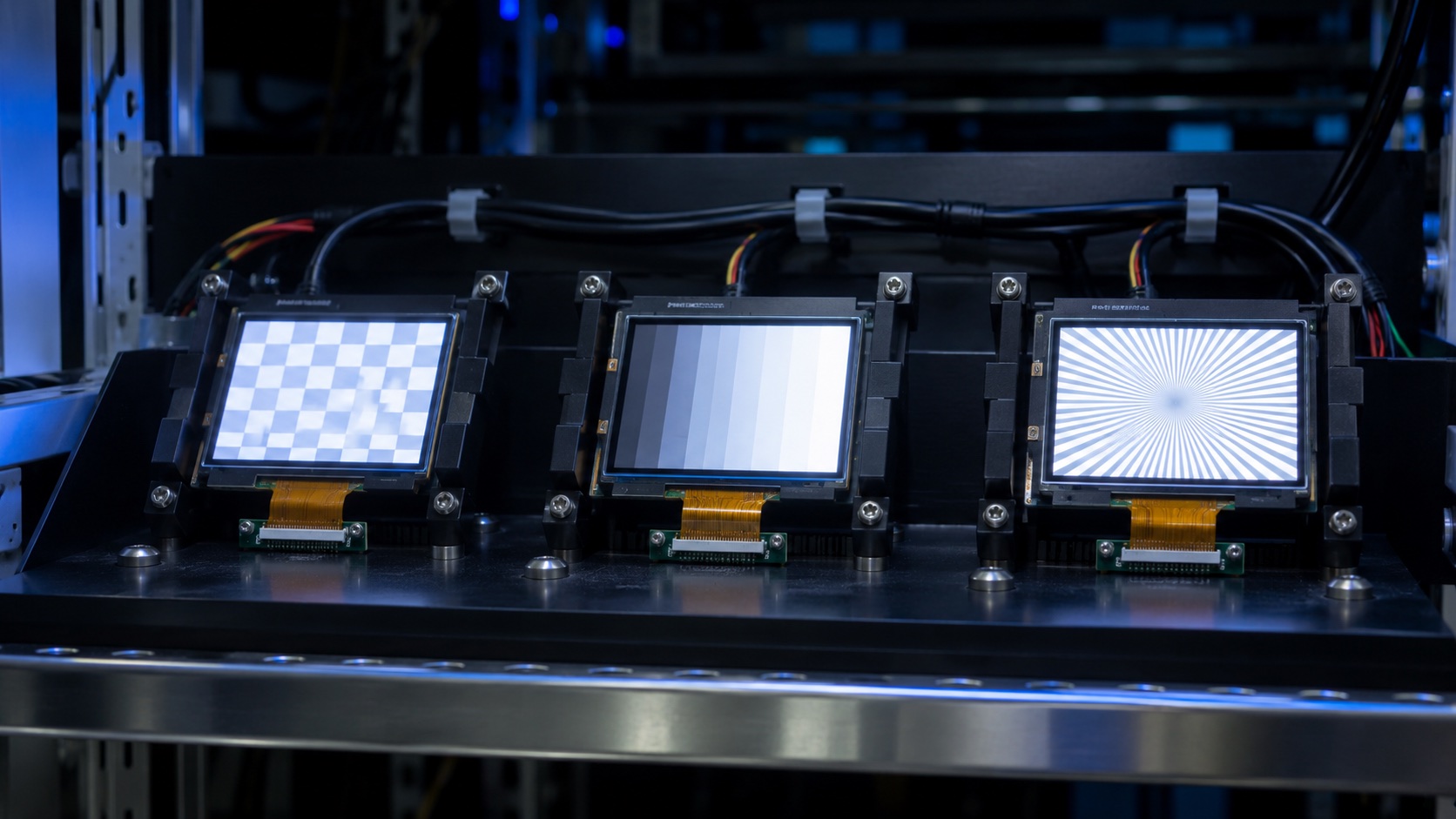
Hero image: AI-generated editorial illustration.
Frequently Asked Questions
Does L70 mean 70 percent of displays survive?
No. L70 describes retained light output relative to the initial value under defined conditions.
Is backlight lifetime the whole module lifetime?
No. Other electrical, optical, and mechanical parts can limit useful service.
Can lifetime hours be converted directly into years?
Only as duty-cycle arithmetic with explicit assumptions; it is not a complete reliability prediction.