
TFT LCD Operating Temperature vs Storage Temperature
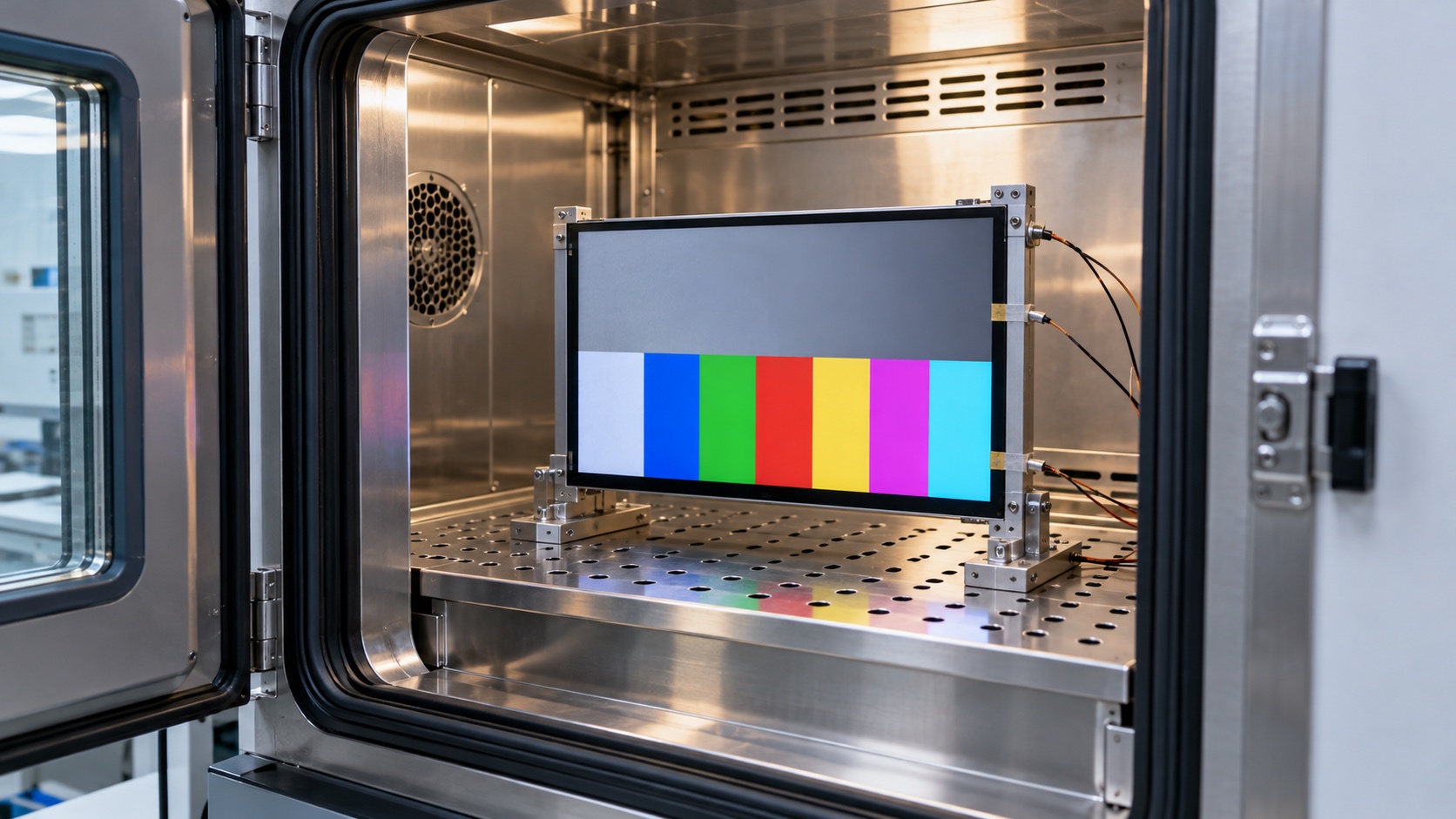
Operating temperature is for powered use; storage temperature is for specified non-operating exposure. A wider storage range does not allow the display to run at those extremes. Both ratings must be read with their test conditions, duration, recovery requirements, and the performance properties actually guaranteed.
This guide explains specification interpretation and test planning. It is not a thermal qualification of any particular module. The Hero is an AI-generated test-chamber illustration, not a laboratory record.
The Two Temperature Ranges Answer Different Questions
| Specification | Main question | What it does not establish by itself |
|---|---|---|
| Operating range | Under what conditions may the module operate? | Constant room-temperature image quality or unlimited service life |
| Storage range | What non-operating exposure is permitted? | Permission to power on at the storage extremes |
| Optical test temperature | At what condition were optical values measured? | The same response time or contrast at every temperature |
| Reliability test condition | What exposure was evaluated, and how? | Qualification for every enclosure or duty cycle |
| Absolute maximum limit | What boundary must not be exceeded? | A recommended continuous operating point |
Keep these categories separate when reviewing a datasheet. The Newhaven NHD-4.3-480272EF-ASXN-T specification, for example, presents temperature limits, optical conditions, and reliability tests in different sections. Reading only the temperature row misses important context.
Use the TFT datasheet reading guide to connect these fields with supply limits, timing, and mechanical requirements.
A Simple Example of the Boundary
Suppose a hypothetical module is specified for operation from −20°C to +70°C and storage from −30°C to +80°C. These numbers are illustrative, not a recommendation or a specification for a product on this site.
At −25°C, the module is outside that example’s operating range even though it is inside its storage range. At +75°C, the same distinction applies. A controller that still produces a visible image at those temperatures does not prove that operation is supported or reliable.
Also ask what “temperature” means in the document: ambient air around the module, a defined case point, or another measurement location. If that is unclear, obtain supplier clarification instead of substituting a convenient measurement.
What Changes at Low Temperature?
Liquid-crystal response generally slows as temperature decreases. A static image may remain legible while moving content, scrolling text, or rapidly changing indicators show longer transitions. Startup behavior can also differ from warm operation.
A response-time value measured at room temperature should not be assumed at the cold limit. Ask for temperature-dependent data or a functional test that represents the application. A numerical readout updated occasionally may have different needs from a fast-changing waveform.
Test startup after the specified cold conditioning as well as continued operation during cooling. Power rails, reset timing, and backlight behavior may introduce failures unrelated to the liquid crystal itself. Review the LCD power-sequencing guide when separating these causes.
If a heater is proposed, define temperature sensing, startup interlocks, warm-up time, power consumption, and fault handling. A heater does not automatically extend the manufacturer’s rating; the proposed operating method needs supplier agreement and system testing.
What Changes at High Temperature?
Heat can affect contrast, color, response, and the stability of the optical stack. Excessive temperature can disturb the liquid-crystal state and produce darkening or other abnormal appearance. Depending on the cause and exposure, effects may be reversible or permanent; do not promise recovery without evidence.
The backlight, driver electronics, polarizers, adhesives, and touch stack also have limits. Passing an LCD-only test does not qualify a bonded touch assembly with different materials.
Direct sunlight is especially important. The screen and enclosure can absorb solar energy while the backlight and internal electronics add heat. Air temperature measured nearby may be much lower than the temperature at the glass or another critical component.
For outdoor products, combine thermal evaluation with the sunlight-readability assessment. Increasing backlight power may improve luminance while making thermal management harder.
Storage Is More Than an Unpowered Temperature Number
Confirm storage duration, humidity, packaging, orientation restrictions, and protection from condensation or direct sunlight. A qualification exposure lasting a defined period is not a guarantee of indefinite storage at that temperature.
After storage or transport, follow the supplier’s conditioning and recovery instructions before applying power or judging image quality. A cold assembly moved into warm humid air may develop condensation. Avoid treating an arbitrary waiting time as sufficient for every product and environment.
Shipping packaging can change the thermal response. A packed storage test and an unpacked operational test represent different conditions, even when the chamber setpoint is the same.
Define a Complete Thermal Validation Plan
The official scope of IEC 60068-2-1:2025 covers cold testing of energized and non-energized specimens under specified conditions. Referencing a method does not determine your severity, duration, or pass criteria, and does not by itself establish compliance.
Before testing, document the following:
- Configuration: module revision, touch stack, enclosure, mounting, firmware, and power source.
- Conditions: required operational and storage exposures, humidity controls, ramps, dwell, and recovery.
- Measurement points: chamber air and relevant assembly locations, with suitable sensors and attachment methods.
- Operating state: off, cold start, normal use, peak backlight, standby, or other defined modes.
- Functional checks: image content, transitions, touch tasks, current, resets, and host communication.
- Acceptance criteria: permitted changes during exposure and required condition after recovery.
Choose sample quantities and severities based on the product requirement and applicable test plan. Do not silently replace a customer requirement with a convenient standard test example.
Separate Temporary Behavior from Lasting Damage
Record performance before exposure, at the specified test points, and after recovery. This helps distinguish a temporary cold response change from a permanent defect. Preserve images and logs with the actual temperatures and operating state attached.
If a screen darkens, first stabilize the system safely and investigate power, signal, pressure, and temperature. Do not repeatedly cycle an overstressed unit to demonstrate that it sometimes recovers. Quarantine damaged samples and retain the failure history.
Compare delivered modules against the approved revision through incoming inspection. A later change in backlight, polarizer, or adhesive may require renewed thermal evaluation even if the nominal temperature range remains unchanged.
Questions to Resolve Before Ordering
Ask which optical and electrical properties are guaranteed at the range endpoints; whether cold startup is supported; where temperature is defined; what storage conditions apply; and which assembly components were included in reliability testing.
The correct selection is not simply the module with the widest pair of numbers. It is the module and assembly whose documented conditions match the real operating, shipping, and storage environment with an appropriate engineering margin.
Frequently Asked Questions
What is the difference between LCD operating and storage temperature?
Operating temperature describes conditions for powered use under the supplier's stated requirements. Storage temperature describes specified non-operating exposure, with any duration, humidity, packing, and recovery conditions. Storage limits do not authorize powered operation.
Does an operating temperature range guarantee constant response time?
No. Response time, contrast, color, and brightness may vary with temperature. Check which properties are guaranteed across the range and which are measured only at a reference temperature.
Can I turn on an LCD below its rated operating minimum?
Do not assume this is permitted because the temperature is within its storage range. Cold startup needs explicit supplier support and system validation, including power sequencing and any heater control.
Why can an LCD become dark in strong sunlight?
Excessive panel temperature can disturb liquid-crystal optical behavior, but darkening can also have electrical or mechanical causes. Check actual panel temperature and the complete system rather than treating all darkening as reversible overheating.
Is the LCD module temperature rating the finished product rating?
No. The touch panel, adhesives, cover glass, backlight, electronics, enclosure, and internal heat sources must also meet the product's environmental requirements.