
TN vs VA LCD for Industrial Screen Selection
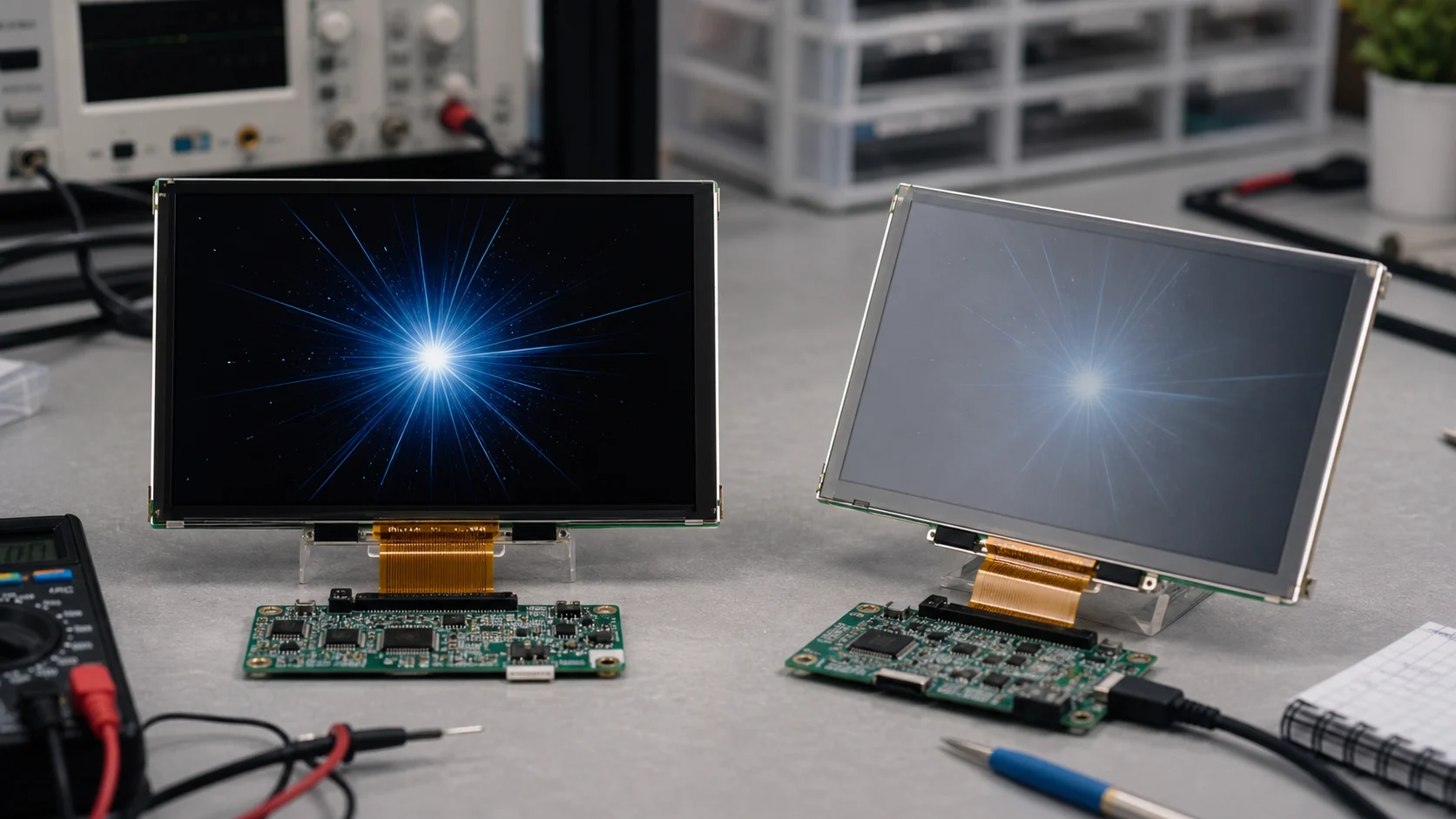
Industrial screen selection often starts with size, resolution, and interface, but panel technology still matters. TN, VA, and IPS LCDs can all be built into TFT modules, yet they behave differently when viewed from an angle, used in low light, or placed in equipment that operators watch for long periods.
TN and VA are sometimes discussed less than IPS because IPS has become the default recommendation for many modern products. That does not mean TN and VA have disappeared. They still appear in cost-sensitive instruments, control panels, replacement modules, and products where specific optical behavior is acceptable.
The practical question is not which technology is newest. The question is which panel type fits the industrial screen’s job.
TN Display Behavior
TN means twisted nematic. It is one of the oldest and most common LCD modes. TN panels are generally inexpensive, fast, and widely available in many legacy sizes. They can be a sensible choice when the user views the screen from a predictable angle and the UI is simple.
The weakness is viewing angle. TN displays can shift color and contrast strongly when viewed from above, below, or the side. In a handheld meter or fixed instrument, this may be acceptable. In a wall-mounted HMI or shared machine interface, it can become a serious problem because different users stand at different heights and positions.
TN also tends to offer weaker black levels and color stability than IPS. For simple numeric displays, status screens, or low-cost controls, this may not matter. For graphical HMIs, warning colors, or camera/video previews, it often does.
VA LCD Behavior
VA means vertical alignment. VA panels usually offer higher contrast than TN and often deeper black appearance than standard IPS. This can make them attractive for dark UI themes, instrument clusters, and products where contrast is more important than color-critical accuracy.
VA viewing angles are generally better than TN but not always as stable as IPS. At extreme angles, contrast and color can still change. Response behavior can also vary depending on the panel design, which may matter for moving graphics or video.
For industrial screens, VA can be useful when the product needs strong contrast, moderate viewing angles, and a display that looks solid in dim environments. It should still be tested in the actual mounting position.
Configuration Matters
The same panel technology can behave differently depending on polarizer, backlight, viewing direction, and optical stack. A TN panel configured for 6 o’clock viewing may look poor when mounted above eye level. A VA panel with a glossy cover lens may lose its contrast advantage under bright reflections.
This is why TFT configuration is part of panel selection. The drawing should define active area, viewing direction, brightness, interface, backlight current, operating temperature, and mechanical limits. If the display is a replacement for an older industrial screen, the viewing direction and connector position may be as important as the electrical interface.
| Requirement | TN Display | VA LCD | IPS |
|---|---|---|---|
| Lowest cost | Strong | Medium | Medium to high |
| Fast simple UI | Strong | Medium | Strong |
| Wide viewing angle | Weak | Medium | Strong |
| High contrast | Medium | Strong | Medium |
| Color stability | Weak to medium | Medium | Strong |
| Legacy availability | Strong | Medium | Strong |
When IPS Is Still Better
IPS remains the safest general choice when multiple users view the screen from different angles, when color stability matters, or when the product is consumer-facing. It is especially useful for smart home control panels, medical-adjacent devices, premium appliances, and industrial HMIs where operators may stand at different positions.
However, choosing IPS only because it sounds better can increase cost without solving the real problem. If a simple device is viewed straight-on and has a limited UI, TN may be enough. If the UI is dark and contrast-heavy, VA may be more appealing than a basic IPS panel.
Prototype Testing
Panel comparison should be done with real content, not only a color chart. Load the product UI, mount the display in the intended angle, and check readability from the user’s normal positions. Test under bright room lighting, low light, and any expected sunlight exposure.
Also check temperature. Industrial screens may operate in cold or warm conditions where response time, contrast, and backlight behavior change. A panel that looks acceptable at room temperature may feel slow or washed out at the edge of the operating range.
Repeat the review with the enclosure installed, because bezel depth and cover glass reflection can change the result.
Replacement and Lifecycle
Industrial products often stay in service longer than consumer devices, so replacement risk matters. If a design uses TN because of a legacy enclosure or controller, confirm how long the panel will remain available and whether an IPS or VA alternative can fit the same opening later. If a design uses VA for contrast, check whether second-source options have similar viewing behavior.
Keep the TFT configuration documented with the panel type, viewing direction, interface timing, connector position, and backlight requirements. This makes future replacement easier and prevents a new module from being approved only because it has the same diagonal size.
Practical Recommendation
Use TN when cost, speed, legacy compatibility, and fixed viewing angle are the main constraints. Use VA when contrast is important and the viewing angle is acceptable. Use IPS when the screen must look consistent across users and product positions.
For a broader comparison, see TN vs IPS vs VA and resolution and aspect ratio. Panel technology should be selected together with the UI layout, enclosure angle, and production lifecycle.
Frequently Asked Questions
Is TN or VA better for industrial screens?
VA usually provides better contrast than TN, while TN may be lower cost and faster. The better choice depends on viewing angle, UI content, lighting, and whether the operator views the screen from a fixed position.
When should an industrial product still use TN display technology?
TN can still be reasonable for simple equipment, fixed-angle viewing, cost-sensitive instruments, and legacy designs where the UI does not need wide viewing angles or rich color.
Is VA LCD a replacement for IPS?
Not exactly. VA can offer strong contrast, but IPS usually provides more stable color and viewing angles. VA is useful when contrast matters and the viewing cone is acceptable.